For over a decade, frontend engineering operated under an artificial divide between pre-rendered immutability and runtime server execution. The Jamstack movement institutionalized this divide by positioning static site generation as the primary defense against latency at scale. Engineering teams accepted protracted compilation cycles, brittle cache invalidation schemes, and heavy client-side hydration burdens simply to avoid origin compute latency. Dynamic application state was treated as an inconvenient deviation from the ideal of immutable edge delivery.
When product requirements inevitably outgrew purely static pipelines, the default countermeasure was a wholesale migration back toward server-side rendering. This resurgence reintroduced the exact performance liabilities that static architecture was conceived to eliminate. Requests routinely stalled at the edge while distributed data stores, authentication proxies, and microservices resolved downstream dependencies before sending initial bytes. Frontend architectures oscillated between the limits of stale reliability and fresh sluggishness without resolving the fundamental structural tension.
"The web shouldn't make you choose between static speed and dynamic power. Partial Prerendering gives you an instant static shell from the CDN edge, while streaming personalized data over the same HTTP request."
Guillermo Rauch, CEO of Vercel, Announcement on X & Vercel Blog
01Partial Prerendering and the Unified Stream
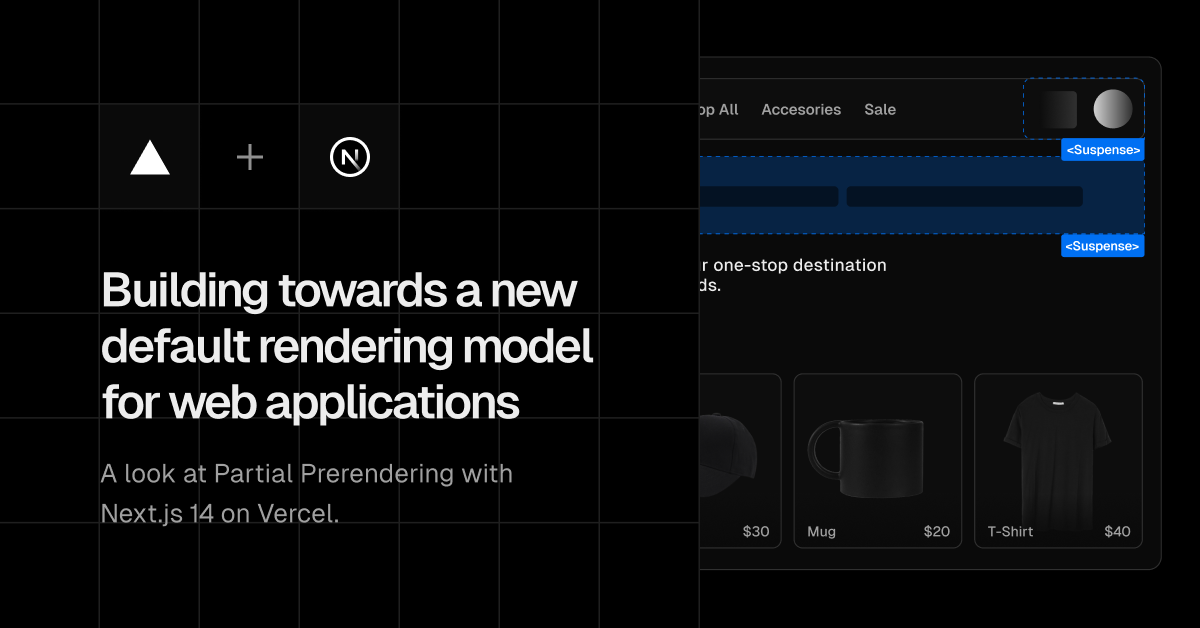
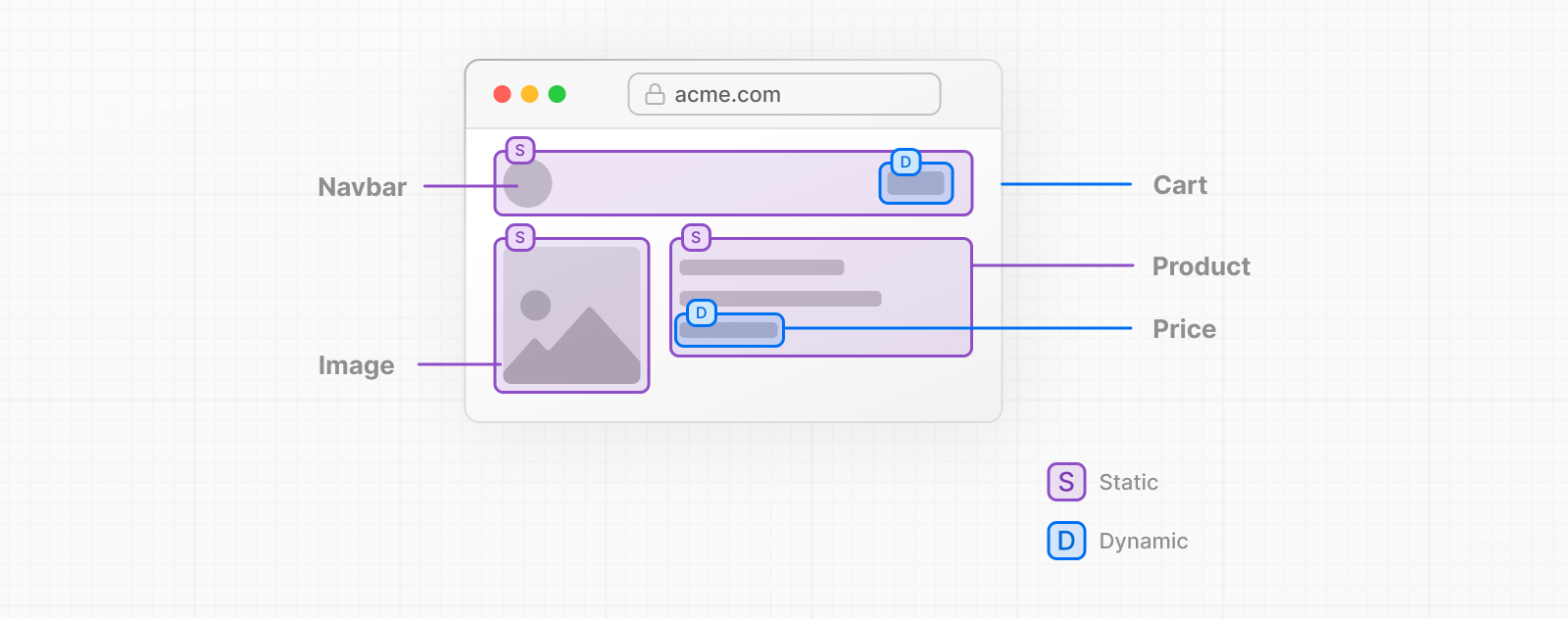
The production normalization of Partial Prerendering (PPR) systematically breaks the operational wall between CDN storage and runtime server logic. Under this architecture, the edge infrastructure immediately transmits an immutable static layout shell on the earliest transport packet. Concurrently, the runtime isolates dynamic data dependencies behind React Suspense boundaries and defers their resolution to asynchronous server worker tasks. The browser begins constructing the Document Object Model within milliseconds of the handshake, removing the initial blank viewport penalty historically imposed by server computation.
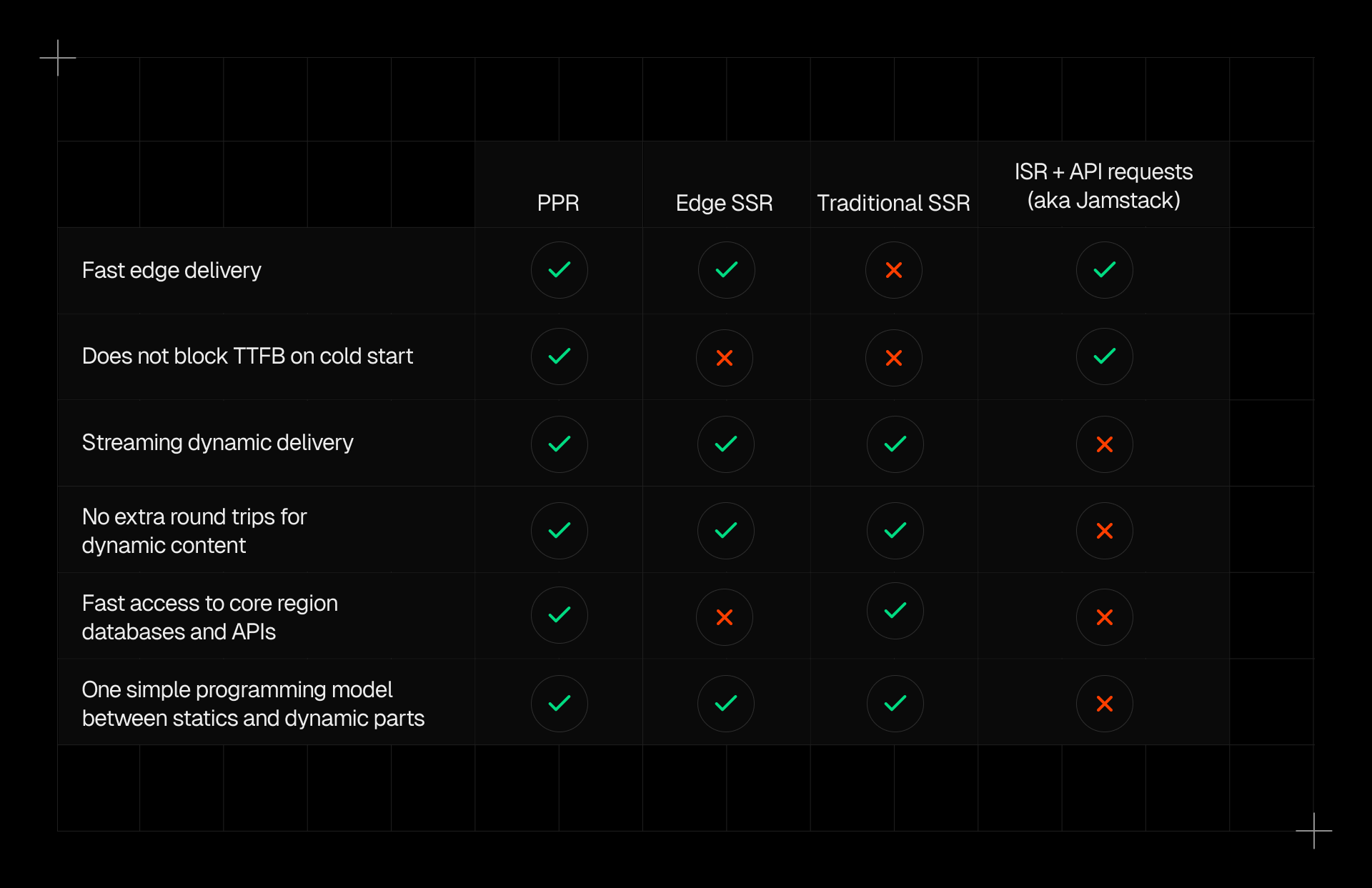
This mechanism relies on an unbroken streaming pipeline governed by HTTP chunked transfer encoding. Rather than triggering subsequent client-side network round trips for client hydration or JSON endpoints, the server injects dynamic HTML chunks into the open connection as upstream asynchronous processes resolve. The browser engine receives and compiles these fragments progressively, mounting completed user interface components without awaiting total page computation. The traditional boundary where content delivery networks hand off execution to application servers dissolves into a continuous data flow.
"Static site generation was great for blogs, and server-side rendering was great for real-time dashboards. But modern applications need both on the same route. PPR dissolves that boundary."
Lee Robinson, VP of Product at Vercel, Reaction on X & leerob.io
By unifying static shell distribution with runtime HTML streaming, the architecture circumvents conventional page-level cache invalidation altogether. Operational teams can update shared product metadata or marketing copy without orchestrating sweeping CDN cache expulsions. User-specific elements, including regional pricing, personalized catalogs, and authenticated credentials, resolve independently inside designated streaming targets. The engineering objective shifts from sustaining global page cache hits to orchestrating fine-grained component resolution over a persistent stream.
Architectural Evolution: Web Rendering Paradigms
- Static Site Generation (SSG): Instant edge delivery and zero runtime compute; constrained by linear build times and complex cache invalidation webhooks.
- Server-Side Rendering (SSR): Dynamic, real-time data resolution; blocked by the slowest upstream microservice or database query before TTFB.
- Single Page Applications (SPA): Fast initial blank HTML payload; heavy JavaScript bundles, delayed First Contentful Paint, and mobile hydration overhead.
- Partial Prerendering (PPR): Instant static layout from edge CDN + streaming dynamic components over a persistent HTTP connection using standard React Suspense.
02The Relocation of the Performance Bottleneck
With initial network delivery decoupled from backend database resolution, conventional web performance metrics require substantial recalibration. Established benchmarks such as Time to First Byte (TTFB) cease to communicate authentic application responsiveness when the initial packet delivers only inert visual framing. An edge response arriving in twelve milliseconds provides negligible utility if personalized application elements require multiple seconds to finish transferring over mobile networks. Measurement systems must shift toward quantifying the duration separating initial layout paint from complete dynamic interactivity.
This transformation shifts the primary constraint on user experience from network transfer latency to client-side main-thread execution budgets. When an application receives markup in fragmented intervals, the browser layout engine executes repetitive layout calculations and style recalculations upon every incoming block. Unchecked component trees delivered through streaming channels can saturate browser task queues and induce visual stuttering. Performance engineering now centers on regulating DOM mutation frequency rather than optimizing origin cache hit rates.
The interplay between streaming fragments and Interaction to Next Paint (INP) presents a delicate engineering balance. Rendering visual scaffolding prematurely invites early user inputs while the client scripts that govern interaction remain unparsed or mid-flight. If a visitor interacts with an element before its backing JavaScript bundle executes, the browser records substantial input delay. Addressing this latency gap requires aggressive script compartmentalization and the scheduling of interaction handlers ahead of secondary visual assets.
03The Economics of Zero-Cold-Start Edge Compute
Streaming partial HTML responses under fluctuating traffic requires an execution tier distinct from traditional serverless functions. Containerized serverless environments impose latency spikes ranging from hundreds of milliseconds to several seconds when waking dormant virtual instances. Maintaining low-latency streaming handshakes across distributed users demands lightweight isolate architectures, exemplified by the V8 engine environment. These isolated runtime contexts initiate in single-digit milliseconds by sharing baseline memory structures across concurrent execution threads.
This compute architecture alters the financial structure of enterprise cloud hosting. Container configurations frequently require organizations to provision idle baseline instances to insulate production traffic from container startup delays. Isolate-driven architectures allocate memory and CPU cycles exclusively during active promise resolution. Cloud billing models consequently align with precise execution durations rather than idle compute availability, improving infrastructure unit economics.
These gains in initialization speed impose strict constraints on application dependency architecture. Isolate runtimes deliberately omit native operating system bindings, full POSIX abstractions, and arbitrary compiled binaries. Development groups modernizing enterprise codebases must adopt database drivers and cryptographic packages that adhere to WinterCG runtime specifications. Securing sub-millisecond execution starts requires a disciplined pruning of the server-side dependency graph.
04The Infrastructure Entanglement Dilemma
The structural consequence of this evolution is an accelerating entanglement between application frameworks and cloud hosting fabrics. Partial Prerendering and streaming pipelines are not generic protocols maintained by neutral regulatory bodies. Instead, they represent proprietary execution contracts negotiated directly between framework compilers like Next.js and specialized edge infrastructure optimized to run them. The technical division between application source code and cloud hosting architecture has effectively disappeared.
Deploying these multi-tiered streaming workflows to alternative cloud providers introduces significant operational overhead. While the foundational transport relies on open web standards, the generated build artifacts target specific routing meshes and edge caching primitives. Engineering teams adopting these runtime patterns exchange short-term operational speed for medium-term architectural lock-in. Migrating a dynamic streaming application away from its parent platform requires either abandoning partial rendering capabilities or maintaining complex emulation layers.
This trend foretells an irreconcilable split within modern software architecture. One ecosystem segment will favor conservative, self-contained runtimes that preserve portable deployment boundaries across arbitrary commodity servers. The opposing segment will accept proprietary platform integration in exchange for the competitive advantages of zero-latency edge streaming. As dynamic streaming becomes standard practice across the web, engineering leadership must acknowledge that frontend performance is no longer an isolated code metric, but an explicit financial and structural commitment to specialized cloud platforms.
End of entry