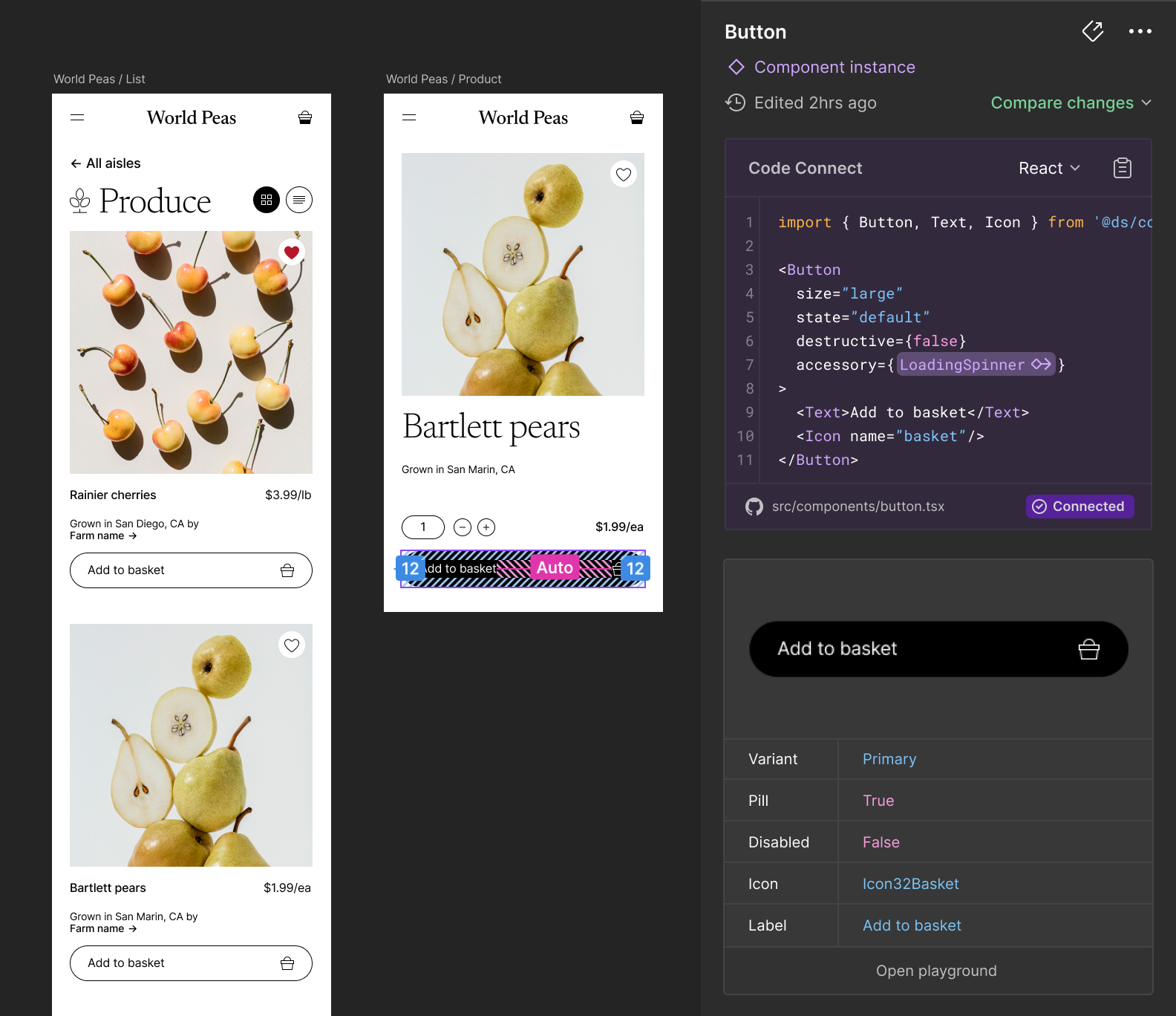
Figma’s integration of production repositories into Dev Mode does not merely accelerate workflow. It strips the design canvas of its sovereign status and formalizes code as the singular interface authority.
01The Dissolution of the Handoff Myth
For more than a decade, product engineering organizations accepted the fiction of the design handoff as a permanent law of software production. The term itself, borrowed from twentieth-century manufacturing assembly lines, implied that visual blueprints could exist as complete, self-contained specifications prior to compilation. In software, this premise was always flawed, treating dynamic state machines as if they were static architectural elevations.
The gap between the drawing board and the browser produced an entire cottage industry of translation utilities, redlining tools, and design system governance councils. Teams spent substantial enterprise budgets reconciling the visual fiction in Figma with the programmatic realities of CSS box models, lifecycle renders, and platform-specific constraints. What traditional practitioners categorized as a communication failure was actually an architectural failure stemming from disconnected storage backends.
With the arrival and production rollout of Figma Code Connect, this historic division loses its technical justification. The tool does not optimize the handoff gesture, because handoff itself was an artifact of fragmented tooling. By mapping canvas nodes to live Git repositories, Figma has dismantled the assumption that design artifacts exist in sovereign isolation from execution environments.
"Design handoff is fundamentally broken when engineers have to guess how a canvas element maps to an existing codebase. Code Connect turns the canvas into a live interface for existing production packages."
Dylan Field, CEO of Figma, Announcement on X & @figma
02Inverting the Source of Truth
Conventional commentary around design systems routinely frames new feature releases through the metric of handoff acceleration. The consensus assumes that faster transcription of color values and border radii represents the pinnacle of operational efficiency. This reading misjudges the structural inversion occurring across the modern product stack.
Historically, the design system team maintained Figma UI kits as the ostensible gold standard, expecting engineering teams to mirror every variant change. Yet when an interface reaches runtime, only the production code possesses legal, computational, and functional reality. If an unstyled element renders in a user's browser, no consumer benefits from the fact that the Figma component library possessed the intended hex code. Code Connect formalizes this balance of power by elevating production components in React, SwiftUI, and Jetpack Compose to the primary source of truth:
- Deterministic Prop Resolution: Canvas instance toggles bind directly to typed component signatures in the repository.
- Bi-directional Parity: Discrepancies between visual variants and codebase props trigger immediate configuration warnings inside Dev Mode.
- CLI Template Generation: Engineers define component relationships via
@figma/code-connecttemplate files stored in repository version control.
Under this architecture, the canvas loses its untouchable authority as a primary source. Design components cease to be unilateral instructions that developers must interpret and reconstruct from scratch. Instead, design components function as live interface contracts, bound directly to existing implementations that software teams have already tested, bundled, and deployed.

03Mechanics of the Interface Contract
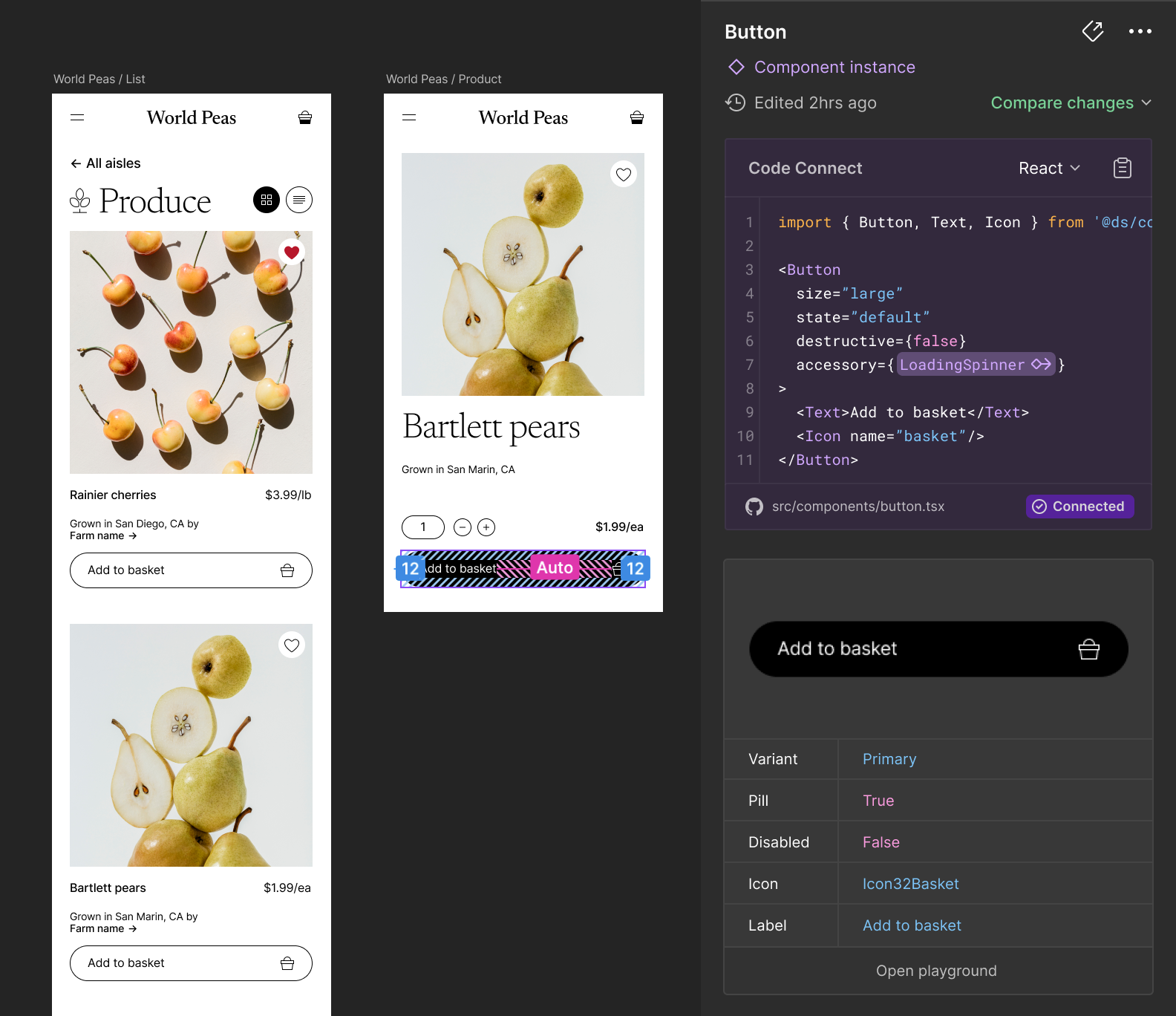
The operational shift becomes concrete when examining the binding mechanics of the toolchain. Rather than relying on automated code generation algorithms that fabricate unmaintainable inline wrappers, Code Connect relies on deterministic mappings defined within repository source trees. Engineers maintain template files adjacent to component source files, registering node URLs alongside explicit property relationships.
```tsx // A Code Connect template binding Figma component variants to production props import figma from '@figma/code-connect' import { Button } from './Button'
figma.connect(Button, 'https://figma.com/design/.../node-id=123:456', { props: { label: figma.string('Label'), variant: figma.enum('Type', { Primary: 'primary', Secondary: 'secondary', }), disabled: figma.boolean('Disabled'), }, example: (props) => <Button {...props} />, }) ```
When an engineer inspects a component instance within Figma's Dev Mode workspace, the panel no longer defaults to generic CSS declarations or hallucinated layouts. It extracts the assigned production component API, resolving variant properties into corresponding component props. A boolean toggle in Figma translates into a typed flag, and nested component instances map into typed composition slots. The canvas thus becomes an interactive consumer of the component library API rather than an arbitrary drawing surface.
This bi-directional parity transforms how cross-functional teams perceive design discrepancies. When a designer adjusts an instance property in a way that has no coded equivalent, the canvas cannot resolve a valid snippet. The tooling forces an immediate realization that the desired state does not exist in the shared library, shifting discrepancy detection from late staging tests to the canvas itself.
"The hardest part of design systems has never been building components – it has always been adoption. When engineers can copy real production code with validated props directly from Figma, translation debt drops to zero."
Jacob Miller, Design Systems Product Lead at Figma, Reaction on X & Figma Dev Docs
04The Political Realignment of Product Engineering
The practical adoption of interface contracts reshapes organizational politics between design and engineering divisions. In most corporate structures, the design system team functions as an internal agency, publishing Figma components with minimal accountability toward compile-time regressions. Simultaneously, front-end engineers refactor components to optimize bundle performance or accessibility compliance without updating design files. This persistent misalignment fostered cynicism regarding the long-term utility of centralized libraries.
Contract enforcement introduces systemic accountability into design file maintenance:
- Continuous Integration Alerts: Modifying a production component signature in Git flags broken Code Connect bindings during pull request checks.
- Enterprise Seat Strategy: Restricting Code Connect capabilities to enterprise subscription tiers shifts Figma from an incidental design tool to required engineering governance infrastructure.
- Living Documentation: Component documentation ceases to be a stale wiki and becomes a synchronized reflection of deployed code.
05Beyond Components: Token Volatility in the Agentic Runtime
While Code Connect successfully resolves component-level parity, it exposes an adjacent vulnerability across multi-tier design tokens. Design systems increasingly rely on semantic and component-level tokens that pass through multiple abstraction layers before resolving to primitive values. When these token trees experience uncoordinated shifts across distributed service branches, component bindings remain syntactically sound while behavioral coherence deteriorates.
This fragility compounds as enterprise teams integrate autonomous coding agents via Figma Model Context Protocol endpoints. AI systems parsing scene graphs through Code Connect can construct syntactically valid components that faithfully mirror current imports while completely misinterpreting runtime layout dynamics and platform view hierarchies. A token change that alters responsive breakpoints or elevation physics will propagate through automated agents without triggering static mapping errors. The interface contract protects the component boundary, yet leaves the runtime environment vulnerable to automated semantic drift.
As design-to-code pipelines transition from human transcription to agentic synthesis, the boundary between design tools and deployment runtimes will dissolve entirely. The next governance dispute will not center on whether designers and engineers share a single button definition. Instead, organizations will struggle to contain the systemic drift introduced when autonomous models interpret living interface contracts across diverging platforms, leaving static canvas representations further behind.
End of entry