The prevailing consensus regarding enterprise software purchasing treats the subscription model as an inevitable historical endpoint. For two decades, centralized multi-tenant architecture was the only viable antidote to the operational morass of local deployment, patching, and database administration. The introduction of the ONCE software catalog by 37signals disrupts that narrative by delivering self-hosted web applications sold for a single payment with full source code access. Commentators who dismiss this initiative as sentimental nostalgia for 1990s desktop licensing fundamentally misunderstand the technical shifts enabling it.
The early software-as-a-service transition solved authentic operational crises. During the late 1990s, deploying enterprise web applications demanded specialized system administrators, relational database tuning, custom network routing, and fragile script dependencies. Software vendors absorbed those hosting liabilities into centralized cloud infrastructure, offering relief to businesses unable to maintain bespoke operations teams. What began as an operational service agreement eventually mutated into an extractive commercial regime where vendors capture economic rent disconnected from their actual infrastructure expenses.
This economic disconnect becomes apparent in per-seat subscription mechanics. Modern software pricing models convert organizational headcount into an unearned recurring tax. When an enterprise grows from fifty employees to five hundred, its internal messaging application consumes negligible additional storage or compute resources. Yet under standard subscription contracts, the vendor multiplies invoice totals tenfold without delivering commensurate improvements in baseline application utility.
"SaaS was a breath of fresh air. Then the bill came due. Now it's a recurring nightmare. Pay forever, own nothing. We're offering a different way: pay once, own it forever."
Jason Fried, Co-founder of 37signals, Announcement on X & ONCE Manifesto
01The Collapse of Deployment Friction
The commercial durability of multi-tenant software rested on the assumption that self-hosting remains prohibitively complicated. That operational assumption collapsed under the steady maturation of container virtualization and localized deployment tooling. Modern container engines like Docker and automated deployment tools like Kamal bundle web runtimes, application assets, and background job processors into single immutable packages. Deploying an enterprise-grade utility no longer requires an entire operations department.
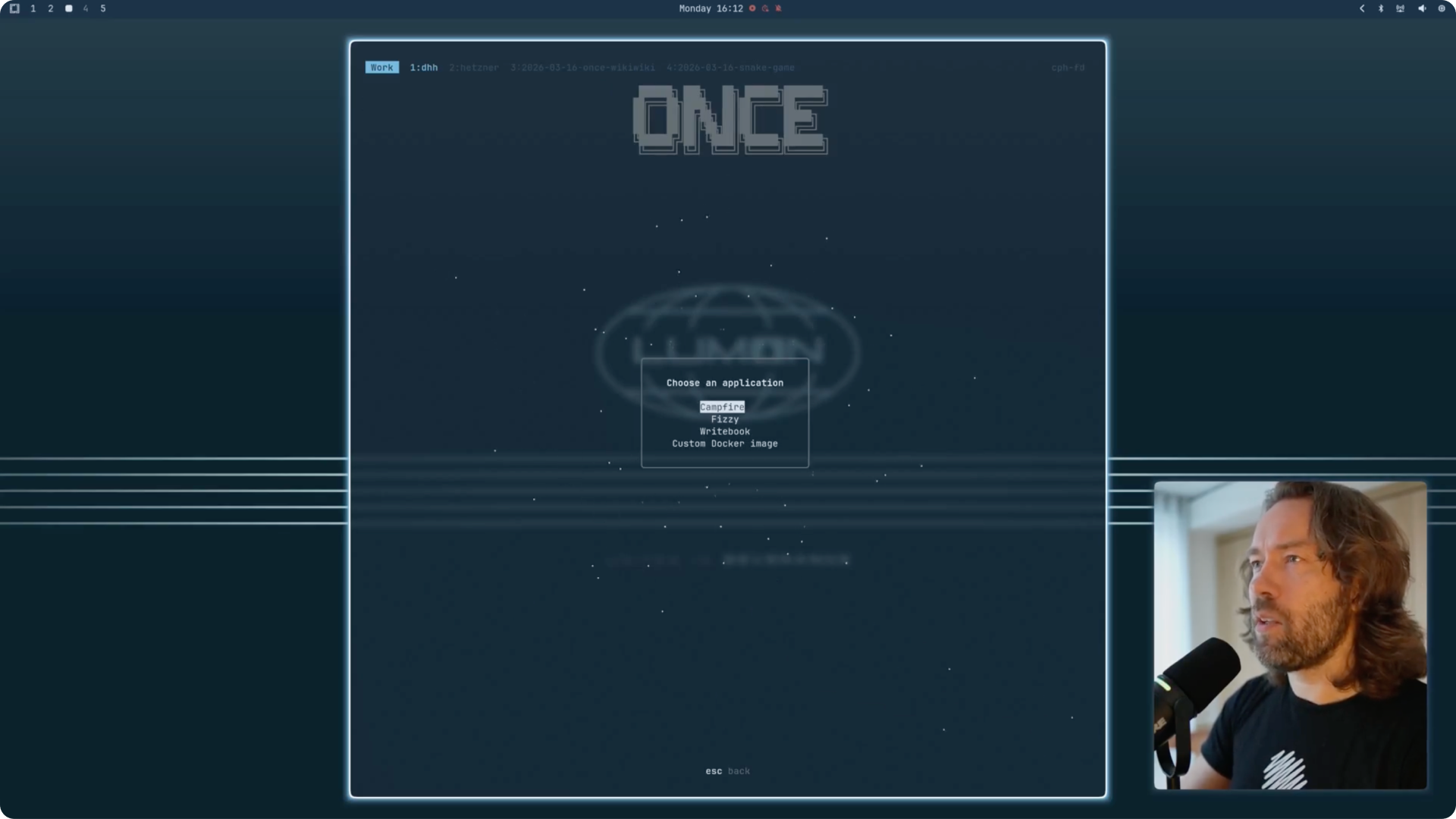
The launch of Campfire demonstrates this operational shift. The system provides an entire organization with persistent group messaging, media handling, and search functionality for a one-time purchase price of $299. Instead of configuring intricate cloud networking layers, an operator executes a single shell command to initiate an automated container download. The software binds directly to host hardware or a modest virtual server, eliminating ongoing per-seat billing in perpetuity.
"The cloud makes sense for two kinds of companies: when you're tiny and have no clue what you're doing, and when your demand is wildly unpredictable. Everyone else is paying a 100% to 300% premium for the privilege of renting computers."
David Heinemeier Hansson (DHH), CTO of 37signals, Reaction on X & Leaving the Cloud
Data persistence has undergone a parallel architectural rationalization. For decades, multi-user web applications depended on distributed database clusters like Postgres or MySQL that imposed steep configuration overhead. Modern applications increasingly rely on embedded storage engines like SQLite paired with Litestream replication, which handle millions of records in a single local file while continuously streaming changes to inexpensive object storage. This streamlined database architecture permits an application to run inside an inexpensive compute instance without performance degradation.
5-Year Total Cost of Ownership: Slack vs. Once Campfire
- 50-seat team on Slack Business+ ($15/user/month): $9,000 annually – $45,000 total over 5 years
- 200-seat team on Slack Business+ ($15/user/month): $36,000 annually – $180,000 total over 5 years
- 50 to 500-seat team on Once Campfire ($299 perpetual license + $10/month VPS): $299 one-time + $600 hosting – $899 total over 5 years
- Enterprise switching delta: Over 98% direct reduction in communications operating expense, decoupled from headcount fluctuations.
02Code Sovereignty and Commodity Utilities
The pushback against subscription software highlights the commoditization of fundamental business workflows. Core digital utilities like team messaging, documentation hosting, and project collaboration reached functional maturity years ago. The persistent stream of interface modifications, algorithmic feeds, and unwanted enterprise add-ons inflicted by subscription vendors rarely serves user productivity. Instead, continuous product churn serves the vendor's internal mandate to justify recurrent monthly fees to public market investors.
Distributing complete source code returns administrative agency to the licensee. When software is delivered as an inspectable codebase rather than a remote black box, the buyer secures operational durability. An enterprise can audit the code for privacy requirements, inspect internal data pipelines, or customize specific business logic without waiting on external roadmap prioritization. If the vendor alters its commercial terms or terminates development entirely, the running instance remains undisturbed on customer hardware.
The distribution of Writebook extends this philosophy across non-commercial publication channels. The application delivers clean typographic presentation and collaborative manuscript editing without cloud platform telemetry or monthly charges. By offering the Rails source code directly to users, the model proves that software craftsmanship can exist outside venture capital growth loops. The economic equation flips from continuous extraction to permanent organizational capability.
03The Long-Tail Asymmetry of Perpetual Maintenance
While the unit economics of buying software once appeal to finance teams, the model introduces a severe structural tension into software maintenance. A company that collects revenue only at the point of sale assumes an open-ended customer support liability as the user base expands. Over a five-year horizon, operating system kernels change, browser rendering engines evolve, and novel cryptographic standards render legacy runtime dependencies obsolete. If buyers expect security patches without paying renewal fees, the vendor faces diminishing marginal returns on every historical customer.
This support asymmetry poses operational hurdles for non-technical buyers. In a subscription arrangement, the vendor absorbs the ongoing labor of database index maintenance, certificate renewals, and edge routing failures. When a self-hosted instance suffers local disk corruption or unhandled network faults, the absence of an integrated operational support desk shifts emergency triage back to the customer. Small organizations lacking dedicated systems talent may discover that eliminating monthly software subscription costs merely converts SaaS line items into variable consulting expenses.
Future market equilibrium will likely bifurcate along utility boundaries. High-velocity systems that depend on global network graphs, real-time telephony switching, or dynamic machine intelligence pipelines will remain firmly anchored within multi-tenant cloud architectures. Conversely, discrete business utilities with stable feature requirements will increasingly migrate toward self-contained container images distributed under perpetual terms. The longevity of this post-SaaS movement hinges on whether independent software vendors can establish sustainable paid upgrade rhythms without sliding back into the subscription rent-seeking they initially set out to dismantle.
End of entry